Description
Rare horn here!
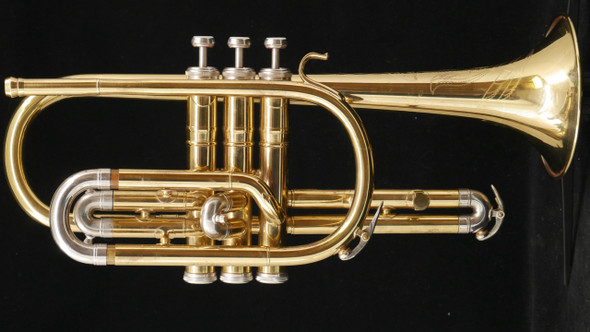
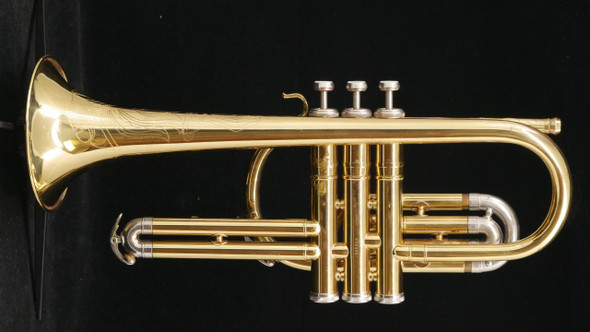
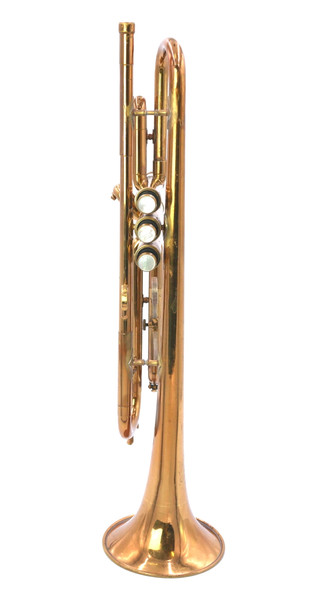
This classic Conn Trumpet came to us via recent trade to the shop. This is one of the rarer Conn trumpets out there and only made for a few years. The 22B NY Symphony has the nickel trim, extensive bell engraving, and some different bracing position.
I really enjoy playing this horn. It's crisp, clean, extremely easy to play, and sounds just tremendous! The efficiency of these small bore conn's are amazing!
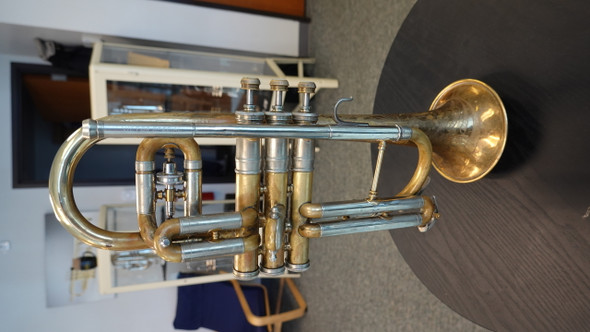
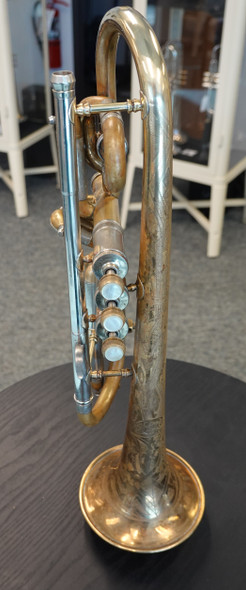
The horn has obviously been played and as you can see in some of the photos shows it's age, although it shows it gracefully!
Some general condition notes:
Horn has original finish although worn in a few areas. That "honey-brown" lacquer is from oxidation over the decades (And looks IMO really great!).
Valves show slight wear and have fair compression. I find with the .438 bore horns you can get a way with a bit of compression loss. This horn plays VERY well with a thicker oil like Ultra-Pure Black Label.
Engraving is intact all the way to the bell bow but hard to photograph
No major dings or other trauma
The horn has some red-rot in the mouthpipe (we can source a recreation 22b pipe if needed but the pressure test showed no leakage).
Sold with no case or mouthpiece
Here's how the great Conn Loyalist page describes this trumpet.
This is the "Special" version of the 22B "standard" New York Symphony. The difference is in the nickel trim and the more extensive engraving on the bell of the "Special". At least some of the braces in the 22B Special are slightly moved compared to the normal 22B, as far as I know all slightly "upstream", towards the player (if anyone knows why, please let me know). Other than these differences it is exactly the same as the "standard" 22B New York Symphony; bottom spring valves, #1 (0.438") bore. Someone told me that the 22B New York Symphony Special does not have "22B" stamped underneath the mouthpiece receiver in addition to the "N.Y. Symp. Special" engraving on the leadpipe, which suggests that these instruments were built as a 22B New York Symphony Special, and not a "regular" 22B which was later spruced up to be a 22B Special. The moved braces would support this. It has also been suggested that the "Specials" were constructed with more care the the normal versions. From what I have seen of the excellent valves of a very beat-up 1936 22B Special, that would be true.
Of the 22B Specials that you see these days, about 75% have been poorly relacquered, with the nice engraving buffed to oblivion. The other 25% have original lacquer in poor condition. Since the 22B Special was very much a professional instrument, that would support the idea that they were played to death at the time. This is the only 22B Special I have seen that is in good (or at least decent) original condition with original lacquer.
A previous owner of a 22B Special had this to say about it upon first receiving it:
"It speaks so easy, the tightest, best responding horn I have ever played. Most horns I have played feel like I am blowing into something external. This horn seems to connect to the player like it is an extension of your body. With the ever so slightest effort the horn responds."
Another 22B Special owner says this about the instrument: "The horn responds very well, especially in the lower registers. What I thought was really unusual, was the intonation of the horn: the low D which is typically sharp was dead on, no lipping necessary. The C# did need to be adjusted, but not that much. Overall intonation is awesome! It slots particularly well; nice centered rich sound. As I got into the upper registers, above high c, I could play higher a lot easier due to the smaller bore, but it was not as open as my Bach 'Strad'. I was playing the horn with a mouthpiece that had a standard throat and backbore size, so maybe the suggestion of opening things up on the mouthpiece side will help a bit. I can't wait to play this in my community band setting, it is just perfect for that. Nice rich tone, great flexibility on wide intervals, fast valves for those barn burner circus marches. Also, ability to blend with all the 'veterans' who still have their axes from the 30s, 40s, 50s, as I always had trouble blending with my larger bore horns in this setting. It also has a nice jazz sound."
I have found a Conn ad from 1942 that shows a picture of Jimmy Dorsey's trumpet section consisting of Shorty Solomson, Ray Anthony, Jimmy Campbell and Nate Kazebier. It says "All play Conn New York Symphony Specials."
The 22B New York Symphony Special was produced between at least 1934 and 1941. I haven't yet seen a 22B New York Symphony Special with a confirmed production date after 1941, so I suspect production of the "special" didn't restart after the war.
What Conn said in 1941:
The New York Symphony Special trumpet is remarkable for its amazing trumpet tone. As one great symphony player said, "It is the closest equivalent to vocal perfection I have ever experienced. Its tone sings, not penetrates, above the orchestra." Here is trumpet performance that will thrill the most experienced trumpet player. Needless to say with reference to such an instrument, the intonation, response, workmanship, and valve action are the last word. Third valve slide has extra long pull for getting pedal F. Medium-small bore, Key of Bb and A.
If you have additional questions send us an email.
Prior to ordering please check our Shipping and Returns policy.
Also note weight indicated in the ad is shipping weight not actual weight of item.